Q&A with the Terra String Quartet
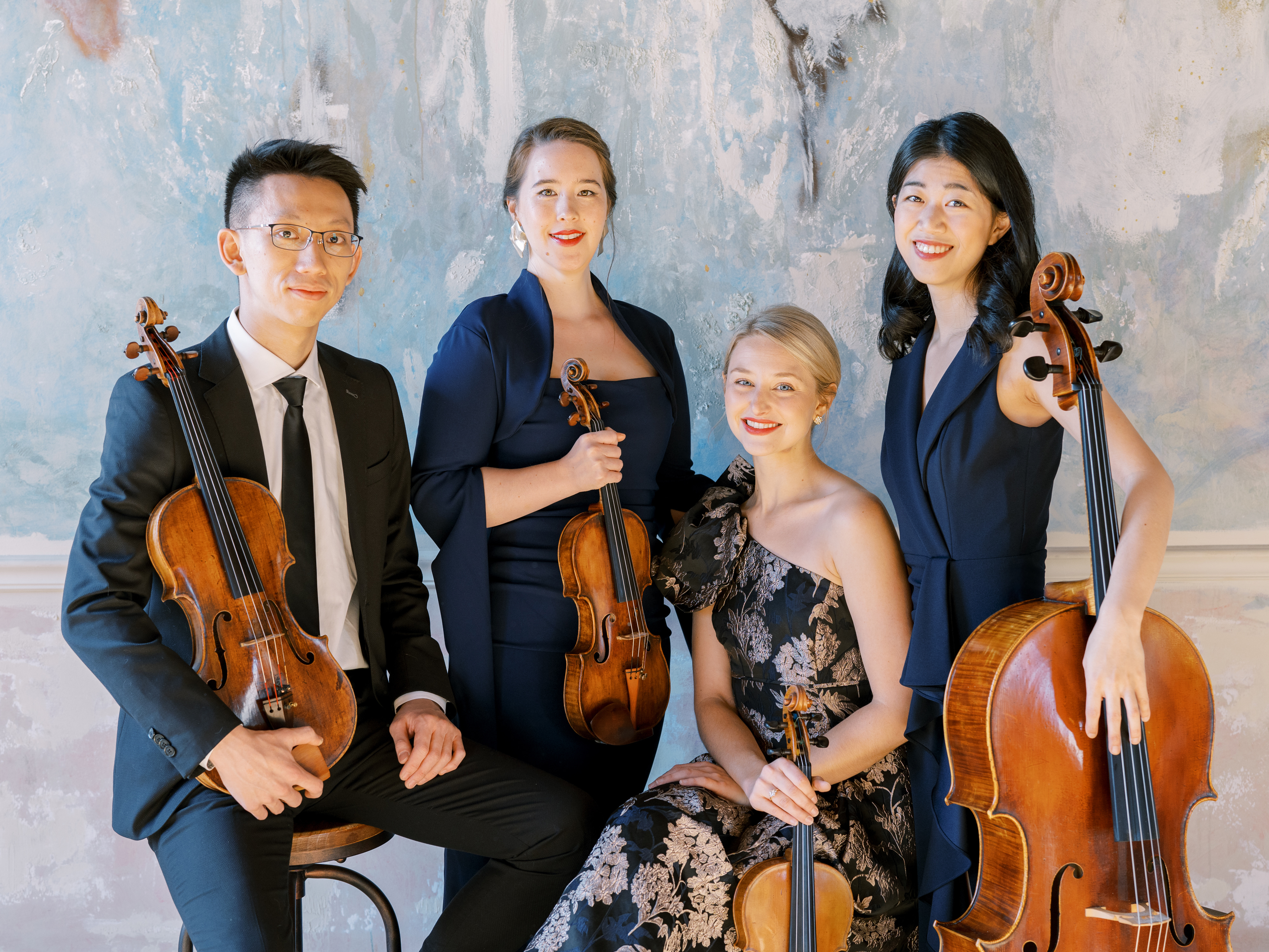
The Terra String Quartet, the School of Music’s Fellowship Ensemble-in-Residence, performs, teaches undergraduates, and refines their craft, all while being mentored by the Brentano String Quartet. In this article, the members — violinists Harriet Langley and Amelia Dietrich, violist Chih-Ta Chen, and cellist Audrey Chen— discuss their experience with the Brentano Quartet, the music of Benjamin Britten, and the dynamics of ensemble collaboration.
Where did the name for your ensemble come from?
Harriet Langley, violin: At the time we formed the quartet, we represented five different continents — some of us being from two different ones — so we thought it was important to reflect that. Half of our parents were non-native English speakers, so we wanted a name all our parents could pronounce, but also one that spoke to the universality of the music we have to offer.
What first drew you to the String Quartet Fellowship at YSM?
Audrey Chen, cello: The Brentano String Quartet. Knowing that they would be our mentors was really exciting. But also, this fellowship is unique in that we have the chance to teach undergraduates in collaboration with Wendy [Sharp] and Sophiko [Simsive]. It’s such a rewarding experience.
Tell us more about working with the Brentano String Quartet.
Amelia Dietrich, violin: When we think about artists that we want to model ourselves after — that have a fulfilling mix of teaching and performing and mentoring — we’ve always looked to the Brentano String Quartet.
Chih-Ta Chen, viola: In our first year, we were mostly preparing for competitions. They helped us a lot, giving us individual attention and keeping our motivation up. Each coaching session with them brings new inspiration. Every member offers something different, and we always leave feeling energized and more connected to the music.
HL: As Chih-Ta mentioned, we’re coming off of a wave of competitions, and now there’s a natural shift to the upcoming performance season. Working with the Brentano String Quartet has given us the confidence to exercise our autonomy while curating and choosing programs.
Speaking of the upcoming concert season: You have a program centered around the work of Benjamin Britten. Can you tell us more about it?
AC: His music resonates with all of us. He captures the feeling of what it’s like to undergo rapid change. And his three string quartets are all so different. They span from when he was a young composer — he was 27 when he wrote the First Quartet — to his death, around the time the Third Quartet premiered. By curating programs around these quartets, we’ve also had the chance to stretch our imagination, thinking about how to bring in other pieces. Recently, we commissioned and premiered a work by Juri Seo that’s based on Britten’s Second String Quartet. In some ways, this project is just a launching pad for our own creative energies.
Being in a quartet means working with four people and accommodating four visions. How do you do that?
AD: One of the best things about being in a quartet is that you have four minds, four very different people. It’s great when we have something like the Britten project that unites us, but it’s even better when one of us brings something they’re passionate about to the group, something new that they can teach us about. It’s a nice reminder that, as much as we work collectively, we all have our own strengths, and that’s what makes us more effective artists — having a team like this. When one person’s really excited about something and shares that excitement, it permeates throughout the quartet.
Do you have any advice for students that are looking to enter the professional world of music?
HL: Make sure to foster friendships and relationships with your peers. These are the people who will be forming festivals that you will attend, the people you ask to play at your concert series, the people that will ask you to play on their album. And with a few years of hindsight, I know this is true. Many of our opportunities came from friends who have recommended us, who we stepped in for, who hired us on a series, who wanted to collaborate.
AD: In my heart of hearts, I believe there is room for everybody in the music world. Staying true to what your musical vision is important because there will always be an audience for it. Whatever it is — whether it’s the well-trodden path or a new one — there will always be people who are interested and who want to support you.
CC: It’s important to tell people what you want. For years, I told everyone — my professors, my classmates — that I wanted to play in a quartet. When I met Amelia at a gig, I told her the same thing. I told her: “You’re doing exactly what I want to be doing. You’re living my dream.” So when the group needed a violist, she remembered and invited me. You have to keep telling people what you want and, one day, it’ll connect.
What have you been most proud of during your time as YSM’s Fellowship Ensemble-in-Residence so far?
AD: We’ve had the chance to be part of so many great performances. We performed at the Venice Biennale; we played with [clarinet faculty member] David Shifrin at the Yale Club of New York City; we performed at the Museum of Natural History; and we had our Carnegie Hall debut thanks to the School of Music. It’s all been so special.
The String Quartet Fellowship offers an exceptional young quartet the opportunity to work closely with the Brentano String Quartet, the School’s ensemble-in-residence, in a residency program at Yale School of Music. The program is designed to mentor the next generation of professional string quartets by offering intensive training and coaching, as well as performance, teaching, and outreach opportunities. Learn more →