Augustin Hadelich

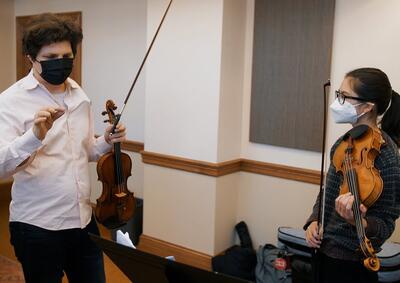
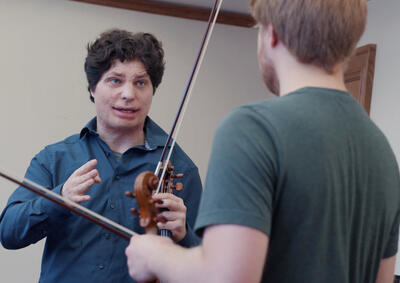
When studying the violin, or any other instrument for that matter, it is essential to know and understand not only one's own part, but the whole score. Putting down the violin and thinking about music away from the instrument has become an essential part of my work and when I teach, I encourage students to reserve time to think analytically about the music they are playing, in order to improve not only how to play the violin, but also why the music was written the way it was, and what it should say. My role in teaching is not only to help with violin-centered technique and advice, but also to serve as a guide in the process of students finding what they want to say to the world as artists.
Augustin Hadelich
Augustin Hadelich has established himself as one of the major violinists of our time. After winning the Gold Medal at the 2006 International Violin Competition of Indianapolis, concerto and recital appearances on many of the world’s top stages quickly followed. He has been honored with such awards as an Avery Fisher Career Grant (2009), the Warner Music Prize (2015), a Grammy Award (2016), Musical America's Instrumentalist of the Year (2018) and two Opus Klassik awards (2021, 2025).
“The essence of Hadelich’s playing,” The Washington Post has opined, “is beauty: reveling in the myriad ways of making a phrase come alive on the violin, delivering the musical message with no technical impediments whatsoever, and thereby revealing something from a plane beyond ours.” The New York Times described Hadelich as a “riveting storyteller” after his world-premiere performance of YSM faculty composer David Lang’s mystery sonatas.
Hadelich’s appearances as a soloist include guest engagements with the most celebrated ensembles in the world, including the Berlin Philharmonic, Bavarian Radio Symphony (Munich), Boston Symphony, Chicago Symphony, Cleveland Orchestra, Finnish Radio Symphony, Los Angeles Philharmonic, New York Philharmonic, Mahler Chamber Orchestra, NHK Symphony (Tokyo), Orchestre de Paris, Philadelphia Orchestra, Royal Concertgebouw Orchestra (Amsterdam), San Francisco Symphony, and Vienna Philharmonic.
Hadelich teaches a limited number of violinists at the Yale School of Music and gives master classes for all YSM string players. He has held residencies at the Colburn School, Curtis Institute of Music, and Kronberg Academy and given masterclasses at Cleveland Institute of Music, Indiana University’s Jacobs School of Music, Hochschule für Musik und Theater in Munich, Manhattan School, and Sibelius Academy in Helsinki, among others.
Born in Italy to German parents, Hadelich earned a Violin Diploma from the Istituto Mascagni in Livorno, Italy, and a Graduate and Artist Diploma from The Juilliard School, where he studied with Joel Smirnoff.