Collection >
Berimbau
Back to Collection Browse
Afro-Brazilian,
20th century
Perere
Bahia
,
1995
Classification: Chordophone
Credit Line: Gift of Robert Farris Thompson
Accession Number: 4203.2010
Department: Yale Collection of Musical Instruments
Description
Musical bow, or simple single-stringed instrument. Played by striking the string with a beater while changing tension in the bow to change the sound. Decorative geometric designs on ends of bow. Origin is probably sub-Saharan African. Eventually came to be used in the Afro-Brazilian martial art 'capoeira'.
Parts and accessories of the berimbau:
- Verga: Wooden bow that makes up the main body of the Berimbau.
- Arame: Steel string.
- Cabaça: Opened, dried and hollowed out gourd secured to the lower portion of the berimbau, used to amplify and resonate the sound.
- Pedra or Dobrão: Small stone or coin pressed against the arame to change the tone of the berimbau.
- Baqueta: Small stick struck against the arame to produce the sound.
- Caxixí: Small rattle that optionally accompanies the baqueta in the same hand.
Capoeiristas split berimbaus in three categories:
- Berra-boi or Gunga: lowest tone.
- Médio (others say 'viola'): medium tone.
- Viola ('violinha' if the medium tone is viola): highest tone
Parts and accessories of the berimbau:
- Verga: Wooden bow that makes up the main body of the Berimbau.
- Arame: Steel string.
- Cabaça: Opened, dried and hollowed out gourd secured to the lower portion of the berimbau, used to amplify and resonate the sound.
- Pedra or Dobrão: Small stone or coin pressed against the arame to change the tone of the berimbau.
- Baqueta: Small stick struck against the arame to produce the sound.
- Caxixí: Small rattle that optionally accompanies the baqueta in the same hand.
Capoeiristas split berimbaus in three categories:
- Berra-boi or Gunga: lowest tone.
- Médio (others say 'viola'): medium tone.
- Viola ('violinha' if the medium tone is viola): highest tone
Dimensions
Overall length: 136.0 cm
Berimbau
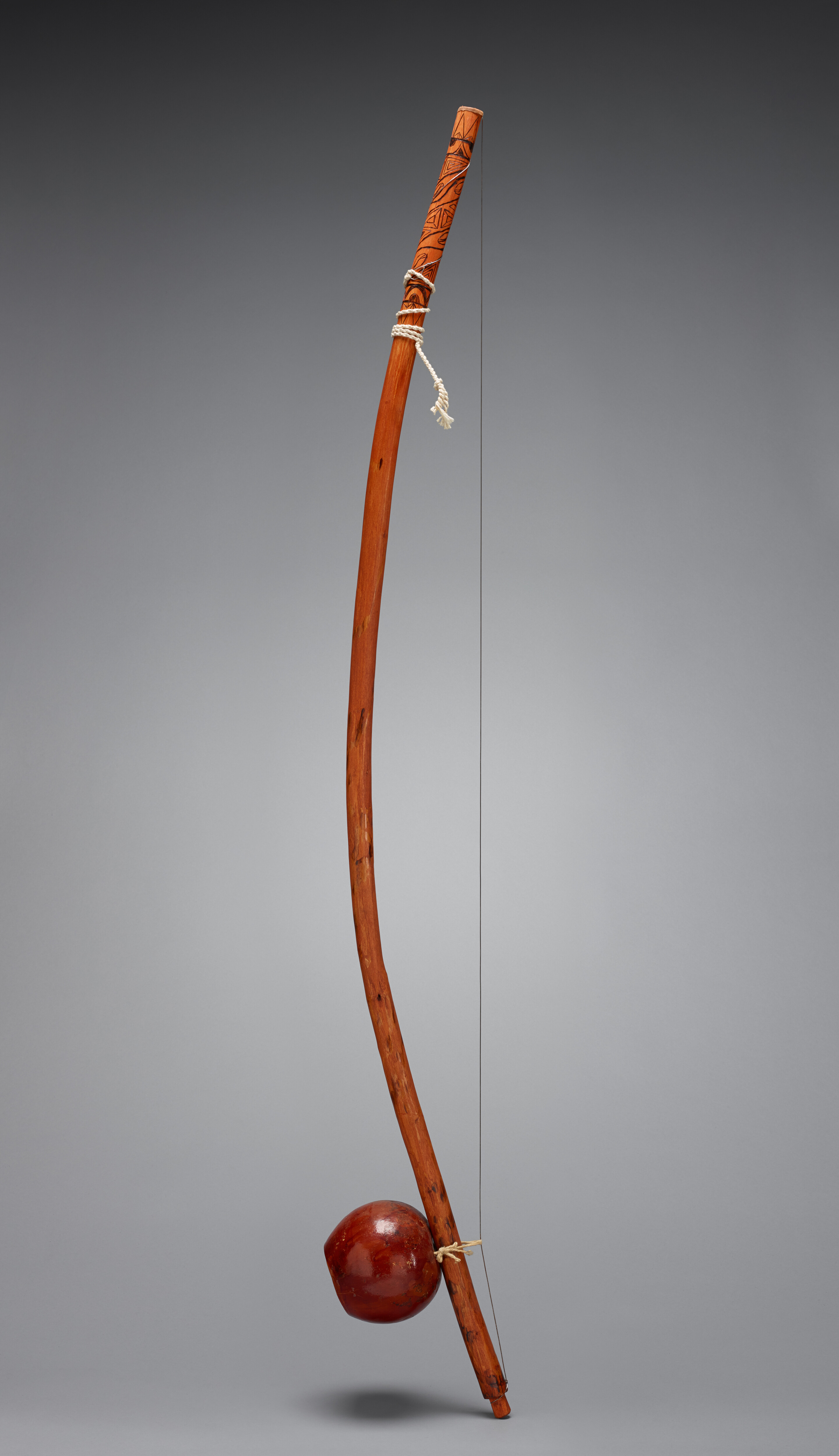
Photo credit: Christopher Gardner
Description
Musical bow, or simple single-stringed instrument. Played by striking the string with a beater while changing tension in the bow to change the sound. Decorative geometric designs on ends of bow. Origin is probably sub-Saharan African. Eventually came to be used in the Afro-Brazilian martial art 'capoeira'.
Parts and accessories of the berimbau:
- Verga: Wooden bow that makes up the main body of the Berimbau.
- Arame: Steel string.
- Cabaça: Opened, dried and hollowed out gourd secured to the lower portion of the berimbau, used to amplify and resonate the sound.
- Pedra or Dobrão: Small stone or coin pressed against the arame to change the tone of the berimbau.
- Baqueta: Small stick struck against the arame to produce the sound.
- Caxixí: Small rattle that optionally accompanies the baqueta in the same hand.
Capoeiristas split berimbaus in three categories:
- Berra-boi or Gunga: lowest tone.
- Médio (others say 'viola'): medium tone.
- Viola ('violinha' if the medium tone is viola): highest tone
Parts and accessories of the berimbau:
- Verga: Wooden bow that makes up the main body of the Berimbau.
- Arame: Steel string.
- Cabaça: Opened, dried and hollowed out gourd secured to the lower portion of the berimbau, used to amplify and resonate the sound.
- Pedra or Dobrão: Small stone or coin pressed against the arame to change the tone of the berimbau.
- Baqueta: Small stick struck against the arame to produce the sound.
- Caxixí: Small rattle that optionally accompanies the baqueta in the same hand.
Capoeiristas split berimbaus in three categories:
- Berra-boi or Gunga: lowest tone.
- Médio (others say 'viola'): medium tone.
- Viola ('violinha' if the medium tone is viola): highest tone
Dimensions
Overall length: 136.0 cm
Afro-Brazilian,
20th century
Perere
Bahia
,
1995
Classification: Chordophone
Credit Line: Gift of Robert Farris Thompson
Accession Number: 4203.2010
Department: Yale Collection of Musical Instruments
Description
Musical bow, or simple single-stringed instrument. Played by striking the string with a beater while changing tension in the bow to change the sound. Decorative geometric designs on ends of bow. Origin is probably sub-Saharan African. Eventually came to be used in the Afro-Brazilian martial art 'capoeira'.
Parts and accessories of the berimbau:
- Verga: Wooden bow that makes up the main body of the Berimbau.
- Arame: Steel string.
- Cabaça: Opened, dried and hollowed out gourd secured to the lower portion of the berimbau, used to amplify and resonate the sound.
- Pedra or Dobrão: Small stone or coin pressed against the arame to change the tone of the berimbau.
- Baqueta: Small stick struck against the arame to produce the sound.
- Caxixí: Small rattle that optionally accompanies the baqueta in the same hand.
Capoeiristas split berimbaus in three categories:
- Berra-boi or Gunga: lowest tone.
- Médio (others say 'viola'): medium tone.
- Viola ('violinha' if the medium tone is viola): highest tone
Parts and accessories of the berimbau:
- Verga: Wooden bow that makes up the main body of the Berimbau.
- Arame: Steel string.
- Cabaça: Opened, dried and hollowed out gourd secured to the lower portion of the berimbau, used to amplify and resonate the sound.
- Pedra or Dobrão: Small stone or coin pressed against the arame to change the tone of the berimbau.
- Baqueta: Small stick struck against the arame to produce the sound.
- Caxixí: Small rattle that optionally accompanies the baqueta in the same hand.
Capoeiristas split berimbaus in three categories:
- Berra-boi or Gunga: lowest tone.
- Médio (others say 'viola'): medium tone.
- Viola ('violinha' if the medium tone is viola): highest tone
Dimensions
Overall length: 136.0 cm